
Sulforaphane and Parkinson’s Disease: How a Natural Compound Supports a Cellular Defense
Parkinson’s disease is increasingly understood as a condition driven by underlying biological stress within the body. Two of the most significant contributors are chronic inflammation and oxidative stress, both of which can damage cells and accelerate disease progression.
Sulforaphane, a natural compound found in broccoli and other cruciferous vegetables, has gained attention for its potential to support the body’s built-in defense systems and help counter these processes.
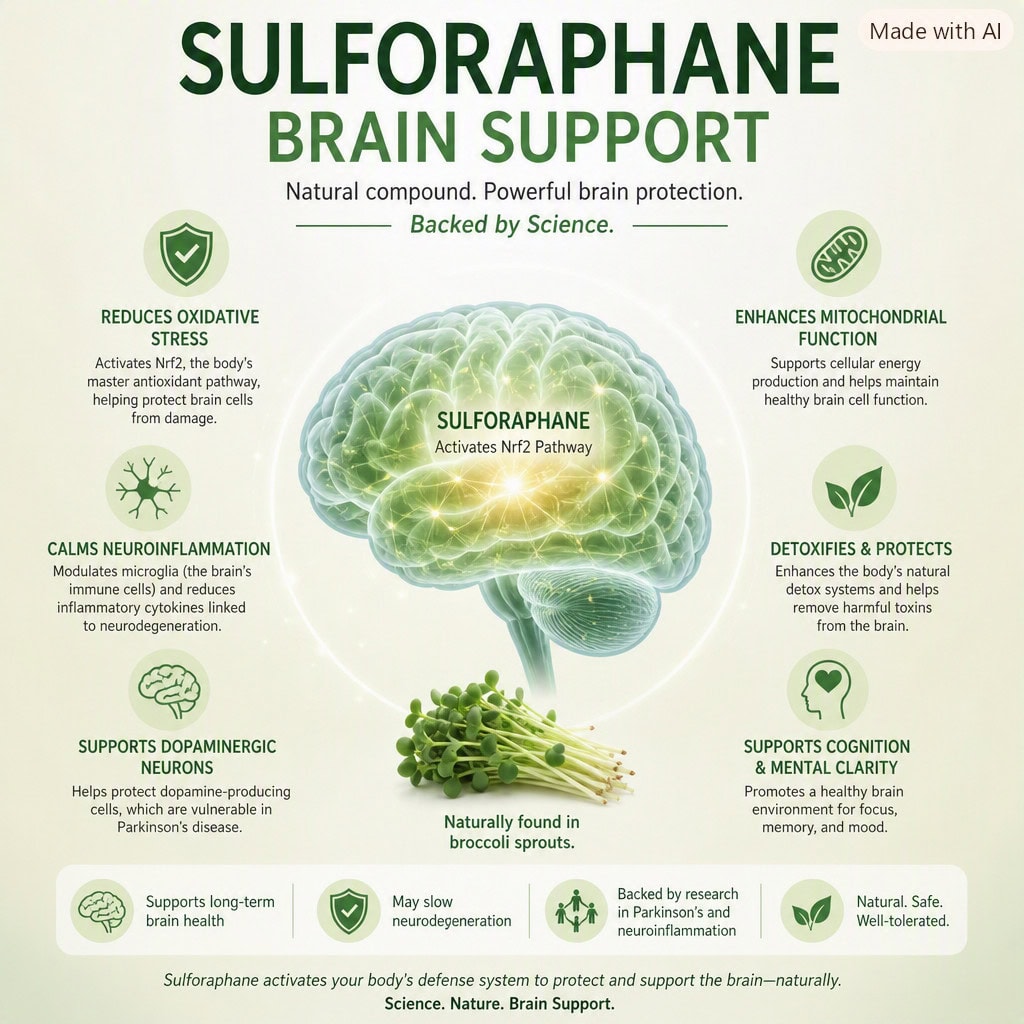
The Two Key Biological Challenges in Parkinson’s
Chronic inflammation
Inflammation is your body’s natural defense system. When you get hurt or sick, your immune system activates to fight infection and begin healing. However, chronic inflammation occurs when this process doesn’t turn off as it should.
Instead of helping, it begins to damage healthy cells. In Parkinson’s, the brain’s immune system can become “stuck on,” gradually damaging dopamine-producing neurons.
Oxidative stress
Oxidative stress is an imbalance between free radicals and antioxidants in the body. When too many free radicals build up, they begin to damage cells, proteins, and DNA.
Over time, this cellular damage contributes to the progression of Parkinson’s and the loss of critical brain function.

How Sulforaphane Works: Activating the Body’s “Master Switch”
Sulforaphane works like a “master switch,” activating powerful defense and repair systems already present in your body.
This process centers around a pathway called Nrf2.
Activating Nrf2 is like turning on a central control system for cellular protection.
Once activated, Nrf2 sends signals to hundreds of protective genes throughout the body. These genes help cells respond to stress and repair damage more effectively.
When Nrf2 is activated, your cells begin to:
- Produce antioxidants – neutralizing harmful free radicals
- Reduce inflammation – calming overactive immune responses
- Support detoxification – helping clear waste and toxins from cells
- Protect mitochondria – preserving the “power plants” that keep cells functioning
Why Sulforaphane Matters for Parkinson’s
In Parkinson’s disease, oxidative stress and chronic inflammation are often elevated. Sulforaphane may help counter these processes by supporting the body’s natural defense systems.
Research suggests sulforaphane may:
- Activate antioxidant defenses – helping protect dopamine-producing neurons
- Calm inflammation – reducing damage caused by an overactive immune response
- Enhance cellular clean-up systems – supporting the removal of harmful proteins like alpha-synuclein
Because of these effects, researchers like Dr. Jed Fahey are actively studying sulforaphane to determine whether activating this pathway can slow disease progression or improve symptoms.
Good Sources of Sulforaphane
Food Sources (Best Starting Point)
Broccoli sprouts are the richest natural source of sulforaphane—containing up to 50 times more than mature broccoli.
Other sources include:
Go Slow and Low
- Kale
- Brussel sprouts
- Cabbage
- Cauliflower
- Bok Choy
- Mustard greens
Start gradually and observe how your body responds, particularly in digestion, energy levels, and inflammation-related symptoms.
Resolve Parkinson’s recommends:
The Sprouting Company as a reliable source of seeds and an easy-to-use sprouting system.
Additional Resource:
Sprouting Guide (Dr. Jed Fahey)

- The active form of sulforaphane is unstable
- Many products may not deliver consistent or effective doses
- Optimal dosing for Parkinson’s is still being studied
Resolve Parkinson’s recommends:
Brassica Protection Products, LLC
Tip: Work with a neurologist or nutrition-focused physician before adding supplements, especially if you are taking medications.
Dr. Wright’s Bioavailable Sulforaphane (Broccoli Seed Tea)
Dr. Albert Wright developed a method of delivering bioavailable sulforaphane through broccoli seed tea (BST).
Resolve Parkinson’s recommends connecting with the Broccoli Seed Tea Club, an international community for individuals interested in learning and applying this approach. Because of its strength and experimental nature, participation requires commitment to understanding the protocol and using it responsibly.
For more information, contact: [email protected]
The information on this website is provided for general informational and educational purposes only and reflects the personal experiences and opinions of individuals living with Parkinson’s disease. It is not intended and should not be used as a substitute for professional medical advice, diagnosis, or treatment.
None of the authors, contributors, or operators of this website are medical professionals, and they do not provide medical advice, make medical recommendations, or offer individualized guidance for any person or situation. Nothing on this website creates a doctor–patient or other healthcare professional–patient relationship.
This website does not recommend, endorse, or make any representations or warranties about the accuracy, completeness, efficacy, safety, or suitability of any specific tests, techniques, procedures, treatments, supplements, products, services, opinions, or other information mentioned here. Discussions of herbal or other supplements are for informational purposes only and are not intended to diagnose, treat, cure, or prevent any disease. In many cases, such products and uses have not been evaluated or approved by any regulatory authority.
You are solely responsible for how you use the information found on this website. The website operator and contributors are not responsible or liable for any interpretation, use, or misuse of the information provided here, or for any loss, injury, or damage allegedly arising from your reliance on it.
Medical knowledge and regulatory guidance change over time, and information on this website may not be current or independently verified. You should always confirm any information obtained from this website with other reliable sources and, most importantly, with your physician or other qualified health-care provider. Never disregard, avoid, or delay seeking professional medical advice from your physician or other qualified health-care provider because of something you have read on, or accessed through, this website. If you think you may be experiencing a medical emergency or a serious worsening of symptoms, call your doctor or your local emergency number immediately.
Explore Further
Read Resolve Parkinson's Origin Story
Learn how Dr. Wright’s work inspired the founding of Resolve Parkinson’s.
Lifestyle Education for People with Parkinson's
Learn about practical strategies for improving mitochondrial health and daily well-being.
Resources for Care Partners of People with Parkinson's
Find tools, guidance, and support for those caring for People with Parkinson’s.
Voices of Parkinson's Video Series
Hear directly from patients, researchers, and care partners shaping the future of care.